Nightmare Abbey and the Comedy of Literary Celebrity
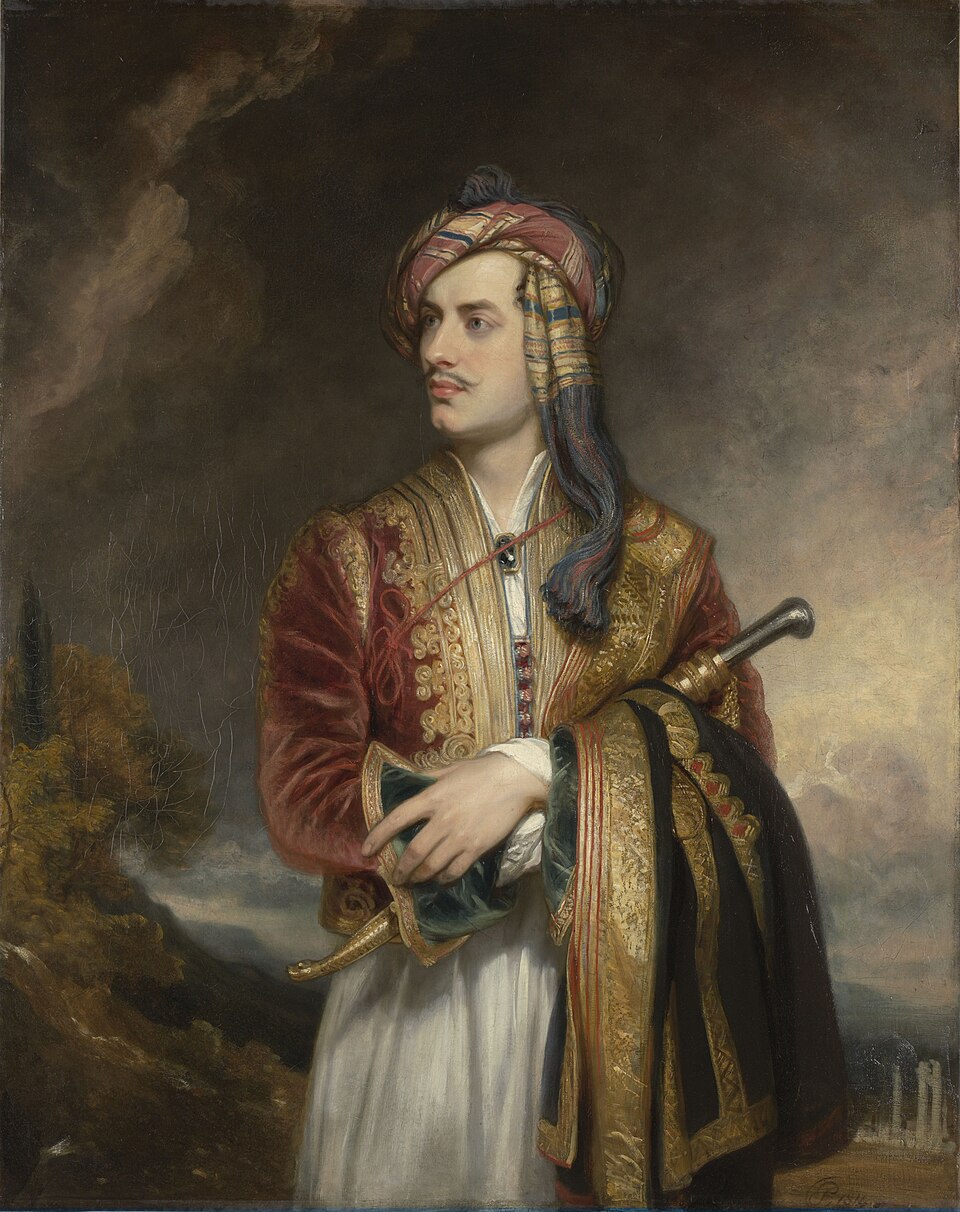
Lord Byron in Albanian Dress, 1813, by Thomas Phillips, via Wikimedia Commons. The poet as Romantic celebrity.
In the previous Peacock summer post, we looked at Nightmare Abbey as a satire of Gothic gloom and Romantic melancholy: the moment when sorrow becomes atmosphere, costume and self-display. This second look turns from mood to personality. Behind Peacock’s abbey stand some of the most recognisable figures of the Romantic age—Shelley, Byron and Coleridge—and a literary culture already beginning to turn writers into myths.
Literary celebrity did not begin with television, social media or the modern book tour. By the early nineteenth century, writers could already become public figures whose lives were consumed alongside their work. Readers did not merely want the poem. They wanted the scandal, the exile, the love affairs, the politics, the quarrels, the look, the voice and the legend.
The Romantic poets were perfectly suited to this new appetite. They seemed to offer not only literature but a way of being: intense, rebellious, wounded, brilliant and utterly out of step with ordinary society. The poet could be a prophet, a lover, an exile, a revolutionary, a sufferer or a doomed genius. Sometimes he was several of these before breakfast. This produced great art but also a great deal of theatre.
Thomas Love Peacock’s Nightmare Abbey, published in 1818, is one of the sharpest comedies written from inside that world. Peacock was not a distant enemy of Romanticism. He knew the people, the talk and the poses. He was a close friend of Percy Bysshe Shelley, understood the aura surrounding Byron and recognised the reverence, irritation and bafflement that gathered around Coleridge. His satire is not philistine. It is intimate.
Peacock and Shelley met in 1812, when Shelley was still only twenty. The meeting came at Nant Gwillt in Radnorshire, where Shelley and his first wife, Harriet, made Peacock’s acquaintance. They did not at once become inseparable, but the friendship deepened after Shelley returned to England and Peacock visited him at Bracknell. Shelley found in Peacock an older, widely read companion with a strong classical mind and a dry, corrective intelligence. Peacock found in Shelley genius, but genius in a dangerously combustible form.
The two men were unlike enough to be useful to each other. Shelley moved towards visions, principles, schemes and acts of imaginative enlargement. Peacock noticed facts, limits, meals, weather, money and the absurdity of human behaviour. Shelley’s instinct was to turn life into a vast moral drama. Peacock’s was to ask when dinner was served.
An anecdote from their 1815 Thames expedition, recounted in our edition of Crotchet Castle & Gryll Grange, gives the relation almost in miniature. Shelley, Mary Godwin, Peacock and Charles Clairmont travelled up the river towards Cricklade, near the source of the Thames. The journey was modest enough, but Shelley’s imagination immediately expanded it. Clairmont wrote to his sister, as recounted by Richard Le Gallienne in Travels in England, that Shelley proposed they should continue by canal and river into the Severn, then through North Wales, Durham, the Lakes, the Tweed, the Forth and finally to the Falls of Clyde: a two-thousand-mile inland voyage.
Reality intervened in the form of a £20 (roughly £2,300 in today’s money) canal fee. Then reeds, shallow waters and cows standing in the river to drink killed the project dead. Peacock’s explanation for Shelley’s rare happiness at Lechlade was more beautifully deflating still: Shelley, normally a vegetarian, had been prescribed “peppered mutton-chops” and had been unable to resist them.
Scythrop Glowry, the young intellectual at the centre of Nightmare Abbey, is Peacock’s Shelley figure. He is not a simple portrait, still less a hostile one. But the Shelleyan traits are obvious: reforming zeal, high romantic expectation, impatience with convention, attraction to abstract systems and a talent for turning private feeling into philosophical drama.
Scythrop wants everything to mean too much. Love must be a theory. Liberty must become a manifesto. Emotional confusion must rise to the level of metaphysics. He is not ridiculous because he is stupid. He is ridiculous because he is clever in a way that has lost all sense of proportion.
Peacock knew exactly what he was doing. In the 1909 edition of Peacock’s Memoirs of Shelley, H. F. B. Brett-Smith calls Scythrop “a lively portrait” of Shelley as Peacock first knew him: devouring tragedies and German romances, troubled by “the passion for reforming the world” and producing a treatise called Philosophical Gas; or, a Project for a General Illumination of the Human Mind. That title alone is half the joke. Scythrop does not merely want to improve humanity. He wants to illuminate the entire species by pamphlet.
Shelley himself appears to have taken the joke well. In one of his letters to Peacock, he praised Nightmare Abbey, called Scythrop “admirably conceived and executed” and saw that the book’s moral might be Falstaff’s great appeal: “For God’s sake, talk like a man of this world.” That is the notion Peacock keeps bringing Romanticism back to: talk like a man of this world. Not a disembodied spirit. Not a martyr to metaphysics. Not a tragic hero in a tower. A man among other people, with ordinary consequences attached to his ideas.
Byron, on the other hand, gave Peacock different material. Shelley was a friend; Byron was a phenomenon.
When the first cantos of Childe Harold’s Pilgrimage appeared in 1812, Byron became famous with astonishing speed. He later wrote that he had awakened one morning and found himself famous. The phrase has become overfamiliar, but Byron was not merely successful. He became an object of fascination. His readers were not content with the poem’s melancholy traveller. They wanted to identify the man behind him.
The Byron who emerged into Regency celebrity was almost too marketable: aristocratic, handsome, lame, scandalous, witty, sexually dangerous, politically wayward and apparently bored with the world. Lady Caroline Lamb’s phrase, “mad, bad, and dangerous to know”, stuck because it sounded like publicity even when it was meant as warning. Byron’s separation from his wife, the rumours around his half-sister Augusta Leigh and his departure from England in 1816 only enlarged the legend. Even death did not bring privacy. After he died at Missolonghi in 1824, his body was returned to England and buried at Hucknall Torkard, with many thousands turning out along the route.
This is literary celebrity in a form we still recognise: art, gossip, charisma, scandal and public appetite feeding on one another. Byron did not merely write the Byronic hero. He became the Byronic hero in the eyes of his readers. In Nightmare Abbey, that world enters through Mr Cypress. He is the Byronic sufferer: elegant, world-weary, darkly eloquent and unmistakably pleased with the effect. Peacock is not denying Byron’s genius. He is mocking the Byronic manner once it becomes a phenomenon unto itself: gloom as glamour, despair as attire, alienation as pose.
Coleridge is present too, usually recognised in Mr Flosky. His comedy is not scandal or self-dramatisation but fog. Coleridge was a great poet, critic and thinker, but he was also famous for metaphysical abundance: talk that could dazzle, inspire and lose everyone in the room. Mr Flosky turns that into pure Peacock. He is the man who will not say something clearly if he can make it sound deeper by making it harder to understand.
So Nightmare Abbey gathers three Romantic personae in comic form. Scythrop is the Shelleyan idealist, trying to force life into the shape of a theory. Cypress is the Byronic celebrity, wearing despair like an expensive coat. Flosky is the Coleridgean sage, wrapping thought in philosophical haze. All three are funny because all three have truth behind them. The setting completes the joke. Nightmare Abbey is not just a Gothic house. It is a mood made habitable. Its gloom flatters the people inside it. They live among shadows because shadows make them appear more interesting. The building gives architectural support to their self-image.
This is why Peacock’s satire still works. We still know the cult of the difficult artist. We still know the prestige of darkness. We still know how easily a writer’s life becomes a performance for readers. We still mistake suffering for depth, obscurity for profundity and publicity for significance.
Peacock’s answer is not to flatten genius into common sense. He admired Shelley and understood the power of the Romantic imagination. But he also saw the comedy of genius when it forgets the world. He saw that a poet might dream of liberating humanity and still be stopped by a canal fee. He saw that vegetarian purity might yield to peppered mutton chops. He saw that literary darkness, once admired, can become a mirror in which a man poses to himself.
That is the sweet sting of Nightmare Abbey. Peacock is not laughing at poetry. The Romantic age produced extraordinary art. He is laughing at the theatre that gathers around poetry: the solemnity, the self-display, the beautiful misery and the conversion of talent into persona.
After Nightmare Abbey, Peacock moved from Gothic rooms and literary self-display into the older, greener world of English romance. Maid Marian changes the scenery, but not the scepticism. Instead of Romantic poets performing their own depth, we explore in the next post how Peacock turns to Robin Hood, the forest and the question of what happens when the people outside the law seem to understand justice better than those who enforce it.
Headlong Hall & Nightmare Abbey is available now in paperback and ebook editions from P-Wave Press and booksellers worldwide.
📚 Explore the book and order here →
The three P-Wave Classics Thomas Love Peacock ebooks are available on Google Play with a tiered series discount during the Peacock summer series.