Maid Marian, Robin Hood and the Politics of Romance
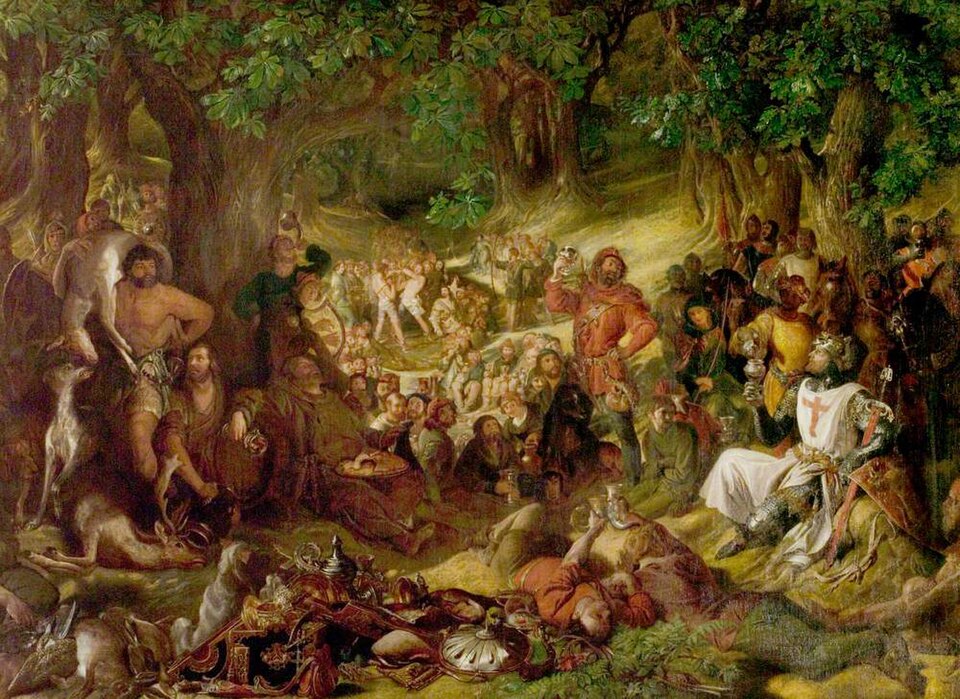
Robin Hood and His Merry Men Entertaining Richard the Lionheart in Sherwood Forest, 1839, Daniel Maclise.
Robin Hood is one of England’s most adaptable political fantasies. He is an outlaw who somehow seems more lawful than the law.
In the previous Peacock summer post, we looked at Nightmare Abbey as a comedy of literary celebrity: Shelleyan idealism, Byronic gloom and the theatre that gathers around poets. Maid Marian moves into very different territory. The setting is no longer the Gothic house but the greenwood; the central figure is no longer the self-dramatising intellectual but the outlaw who makes official authority look morally uncertain.
That is the basic attraction of the legend. Robin lives outside authority, but he often appears morally clearer than those who represent it. He robs, but the robberies are made to feel like correction. He breaks the law because the law, in the world of the story, has already become unjust. The forest becomes a place outside the normal reach of sheriff, court, tax collector and feudal superior, but it is not simply a place of disorder. It is a place where a different kind of order can be imagined.
This is why the Robin Hood story has been repeatedly remade. Sometimes Robin is a yeoman outlaw, sometimes a dispossessed nobleman, sometimes a loyal servant of Richard the Lionheart against Prince John. He has been used as a social rebel, a patriotic hero, a children’s adventure figure, a pantomime presence and a piece of tourist England with a longbow. The details change but the underlying appeal remains.
Thomas Love Peacock’s Maid Marian, published in 1822, takes that familiar legend and turns it into a quick, comic romance about liberty, authority and pleasure. It is not a solemn attempt to reconstruct medieval England. Peacock is not writing like Walter Scott, building a large historical world from law, custom, landscape and political change. His medievalism is lighter and more theatrical. He uses the past because romance gives him a stage on which the absurdities of power can be seen more clearly.
The title is the first clue. Peacock calls the book Maid Marian. Robin remains central to the story, but Marian is not merely attached to his legend as a decorative heroine. Peacock makes her active, spirited and capable of choosing the life of the forest. She is not simply waiting in a castle to be rescued or transferred from one male claim to another.
The forest in Maid Marian is more than scenery. It is an alternative society. It stands outside the official structures of medieval authority: court, castle, church, property and inherited rank. Yet Peacock does not present it as chaos. The outlaws have their own loyalties, customs, hospitality and pleasures. Their world is technically illegal, but it is often more generous and more humane than the respectable world outside it.
That contrast gives the novel much of its comedy. The official world is full of people behaving badly with the support of titles, offices and institutions. The outlaw world is full of people behaving better without any official sanction at all.
Prince John’s authority is compromised because it rests on the absence of Richard. The Sheriff and the officers of law are not figures of justice so much as comic agents of enforcement. Peacock’s clergy, when they appear in their more worldly form, are no less exposed to appetite, comfort and hypocrisy. The lawful world has the language of order, but very little moral authority. The greenwood has the appearance of disorder, but often supplies the justice that the official world withholds.
This is not political theory in disguise. Peacock is not offering a programme for reform by way of Sherwood Forest. He is doing something more characteristic: using comedy, romance and inherited legend to unsettle the dignity of authority.
The form of the book is also important. Romance allows Peacock to simplify, exaggerate and arrange. He can make the Sheriff absurd, the forest liberating, Marian decisive and the outlaw band cheerful without having to account for every practical detail. A more realist novel would have to deal with administration, weather, landholding and the everyday misery of outdoor life. Peacock is interested in something else: what the Robin Hood legend permits the reader to imagine.
What it permits, above all, is a world in which legality and justice have come apart. That is the point at which the outlaw becomes useful. He allows the reader to entertain a morally awkward but emotionally satisfying proposition: that the people outside the law may be closer to justice than the people who enforce it. Marian’s role gives that proposition a more personal form. In many medieval and pseudo-medieval romances, women are treated as prizes, pledges or dynastic instruments. Peacock recognises that convention, but he gives Marian more freedom than the convention requires. Her decision to enter the forest is not only a romantic attachment to Robin. It is also a refusal of the role arranged for her elsewhere.
Peacock does not turn her into a modern heroine in costume, and the novel would become clumsy if he did. Her freedom is expressed through action rather than declaration: movement, disguise, wit, loyalty and preference. She belongs in the greenwood because she is at home in a freer, livelier social order.
The pleasure of the forest is also part of the politics. Peacock repeatedly connects liberty with sociability: eating, drinking, singing, jesting, fighting and choosing one’s companions. Freedom in Maid Marian is not solitary self-possession. It is shared life without servility. The outlaws are not free because they are alone. They are free because they have formed a community in which courage, wit and generosity matter more than official status.
That emphasis is very Peacockian. Bad authority in his fiction is not only unjust. It is pompous, joyless, greedy or tedious. It interrupts songs, polices movement, blocks marriages, spoils fellowship and makes life smaller. By contrast, the freer world is marked by appetite, music, laughter and hospitality.
This also connects Maid Marian with the earlier Peacock novels in the summer series. Headlong Hall satirises intellectual systems: the people who turn optimism, pessimism or improvement into complete explanations of the world. Nightmare Abbey turns to Gothic melancholy and Romantic self-dramatisation. Maid Marian changes the scenery but keeps the scepticism. It distrusts official solemnity. It distrusts claims to authority that cannot justify themselves by conduct. It prefers wit to pomposity and chosen loyalty to imposed obedience.
The novel is therefore lighter than its subject matter might suggest, but not empty. Its politics are carried by tone, arrangement and preference rather than by manifesto. Peacock does not ask the reader to believe that a band of merry outlaws is a practical solution to political corruption. He asks the reader to enjoy, for the length of a romance, a world in which corrupt power can be mocked, evaded and occasionally beaten.
That enjoyment is not trivial. One of the things romance can do is give a shape to political desire before it becomes policy. It can imagine a different relation between law and justice, men and women, power and pleasure, property and generosity. In Maid Marian, the greenwood is not a blueprint. It is a comic counter-world.
Peacock’s achievement is to take an old legend and make it sociable, sceptical and quick. He does not drain Robin Hood of romance in order to make him respectable. Maid Marian is not radical because it proposes a system. Peacock mistrusted systems. It is radical in a lighter, more comic and perhaps more durable sense: it imagines authority as something that can be laughed at, and freedom as something that might be enjoyed.
After Maid Marian, Peacock moves from England’s greenwood to a stranger and older imaginative landscape. The Misfortunes of Elphin turns to Welsh legend, Taliesin and the drowned land of Gwaelod, asking what survives when rulers fail and the story is left to the bard.
Maid Marian & The Misfortunes of Elphin is available now in paperback and ebook editions from P-Wave Press and booksellers worldwide.
📚 Explore the book and order here →
The three P-Wave Classics Thomas Love Peacock ebooks are available on Google Play with a tiered series discount during the Peacock summer series.