Nightmare Abbey and the Cult of Melancholy
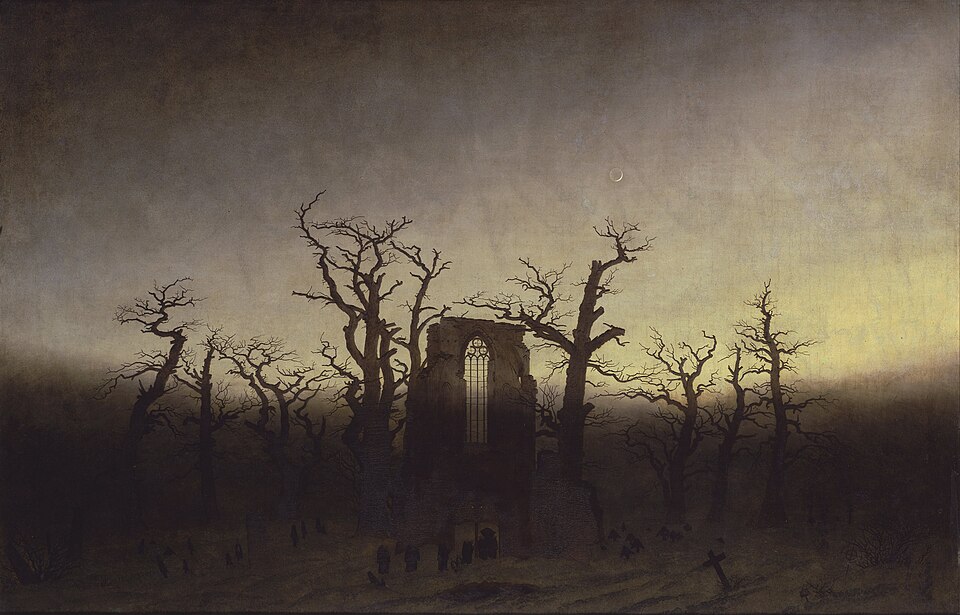
The Abbey in the Oakwood, 1809–10, Caspar David Friedrich. Public domain, via Wikimedia Commons.
In the previous Peacock summer post, we looked at Headlong Hall as a comedy of intellectual systems: optimism, pessimism, improvement and fashionable ideas pushed too far. Nightmare Abbey takes the same comic method and turns it inward. This time the system is not a theory of progress or decline. It is a mood.
Before Gothic was a music scene, a fashion palette and a way of wearing eyeliner, it was a literary mood. In the late eighteenth and early nineteenth centuries it meant ruined castles, mouldering abbeys, persecuted heroines, family secrets, tyrannical fathers, vaults, storms, spectres and an almost luxurious enjoyment of dread. Horace Walpole’s The Castle of Otranto, Ann Radcliffe’s The Mysteries of Udolpho and Matthew Lewis’s The Monk had helped create a fictional world in which darkness was not merely an absence of light. It was an atmosphere, a style and a promise.
Romanticism added something still more potent: the idea that inward suffering might be a sign of depth. The solitary thinker, the disappointed lover, the alienated genius, the rebel against society and the poet at war with the ordinary world all acquired a new glamour. Byron became famous almost overnight with Childe Harold’s Pilgrimage, then seemed to live in public as a version of the brooding figure his readers imagined. Coleridge became legendary not only for his poetry, but for his metaphysics, his talk and his magnificent obscurity. Shelley, Peacock’s friend, was not a poseur in any simple sense, but he was intensely susceptible to systems of reform, ideals of love and visions of intellectual liberation.
This produced great art. It also produced a great deal that was ripe for parody. That is the territory of Thomas Love Peacock’s Nightmare Abbey, first published in 1818. It is a short novel about gloom, but more precisely it is a novel about the moment when gloom becomes a trend. Peacock is not attacking sorrow. He is attacking the self-conscious cultivation of sorrow: melancholy as performance, Gothicism as décor, despair as a sign that one is too refined for ordinary happiness.
The setting is already a joke. Nightmare Abbey belongs to Christopher Glowry, a gentleman who has arranged his life around disappointment. He has chosen a suitably miserable house, cultivated suitably miserable habits and surrounded himself, as far as possible, with people who confirm his view of existence. His domestic world is not simply sad. It is curated sadness.
His son, Scythrop, is the book’s central comic figure: young, intellectual, romantic, impatient, self-dramatising and thoroughly persuaded that his private unhappiness is part of a larger philosophical drama. Peacock modelled him in part on Shelley, though the portrait is not a simple act of mockery. It is affectionate, cutting and uncomfortably precise. Scythrop has Shelley’s reforming ardour, his appetite for abstract schemes, his confidence that thought and passion can remake life. He also has the comic weakness that Peacock saw very clearly: the tendency to turn every emotional difficulty into a matter of world-historical significance.
Scythrop wants to think greatly, love greatly and suffer greatly. He wants to free humanity, overturn dull convention and inhabit a life worthy of his imagination. Unfortunately, life keeps presenting itself in more ordinary forms: family arrangements, romantic confusion, incompatible women and the inconvenience of other people having wills of their own. That collision between grand feeling and comic reality is the life of the book.
Peacock fills Nightmare Abbey with figures who would have been recognisable to readers alive to the literary culture of the day. Mr Flosky, dense with German philosophy and metaphysical fog, is usually read as a satire on Coleridge. Mr Cypress carries obvious Byronic colouring: aristocratic, world-weary, darkly eloquent and pleased with his own despair. Mr Toobad is convinced that the world is governed by the devil and finds evidence for this almost everywhere. These are not rounded realist characters in the later Victorian sense. They are comic embodiments of intellectual and emotional weather.
The comedy depends on a delicate distinction. Peacock does not deny that the age had reasons for disillusionment. Revolutionary hopes had curdled. Europe had lived through war and political disappointment. Religion, philosophy and social theory were all being fought over intensely. The great Romantic writers were not pretending when they wrote about isolation, rebellion, longing and despair. The feeling was real. But real feeling can become fashionable. It can acquire a costume, a vocabulary and a set of gestures. It can become a way of being seen.
That is where the comparison with later Gothic culture becomes interesting. The 1980s Gothic scene produced superb music, a genuinely rich visual language and a subculture that gave many people a way to make beauty out of alienation. But it also produced its share of theatrical gloom, self-parody and people who seemed to have mistaken being miserable for being interesting. The same tension runs through Peacock’s Regency world. The best of Romantic melancholy is art. The worst of it is affectation with better adjectives.
Nightmare Abbey itself is a kind of stage set for this affectation. The abbey, the gloom, the dampness, the ancestral melancholy, the air of cultivated discontent: all of it allows the inhabitants to live inside a flattering image of themselves. They are not merely unhappy. They are aesthetically unhappy. They have made a home out of mood. Scythrop is funny because he has read too much in exactly the wrong way. He does not merely absorb books; he turns them into scripts for himself. He is a reformer, a lover, a philosopher and a tragic hero, often within the same afternoon. His ideas may be serious, but his self-presentation keeps betraying him.
The novel’s plot, such as it is, revolves around romantic entanglement and misunderstanding. Scythrop is pulled between different women, different fantasies and different versions of himself. The machinery is comic, but the target is exact: the Romantic desire to make life answer to an idea. Scythrop does not simply want love. He wants love to confirm his philosophy. He does not simply want freedom. He wants freedom to arrive in a form that flatters his own drama.
Peacock’s method is merciless because he rarely needs to intervene. He lets his characters speak. They come into a room carrying their favourite ideas and very quickly become ridiculous. Mr Flosky cannot leave a thought clear if he can make it obscure. Mr Cypress cannot simply be bored when he can be sublimely world-weary. Mr Toobad cannot encounter an inconvenience without fitting it into a universal theory of diabolical decline. Scythrop cannot experience emotional embarrassment without making it metaphysical.
This is why Nightmare Abbey still works. Its immediate targets belong to Peacock’s own circle and age, but the habit it mocks has not gone away. We still know the prestige of darkness (cf, the potential for absurdity in Batman). We still know the assumption that pessimism is cleverer than cheerfulness, that alienation is proof of depth and that despair, properly phrased, can become a social identity.
The book is not a defence of bland optimism, however. Peacock was far too sharp for that. He knew that the world is foolish, unjust and often disappointing. What he refused was the vanity that attaches itself to disappointment. A gloomy view may be true. It may also be lazy, derivative, theatrical or convenient. A person can be wounded and still vain about the wound. Nightmare Abbey does not say that melancholy is false. It says that melancholy is not automatically profound. It asks what happens when an emotional state becomes a badge of superiority, when literature teaches people not merely how to feel, but how to pose while feeling.
In that sense, it follows naturally from Headlong Hall. Peacock’s first novel satirises intellectual systems: optimism, pessimism, improvement, classification and the fashionable reduction of reality to a theory. Nightmare Abbey turns the same comic method on emotional systems: gloom, misanthropy, Byronic weariness, Gothic atmosphere and the cult of wounded genius. Both novels are about people trapped inside their own explanatory habits. In Headlong Hall, the trap is an idea. In Nightmare Abbey, it is a mood.
What makes Peacock bracing is that he does not plead with us to be more sensible. He simply places clever, vain, unhappy and over-literate people in company and lets the absurdity unfold. The result is not anti-Romantic philistinism. It is a necessary corrective from someone close enough to the Romantic world to know its brilliance, and close enough to laugh at its nonsense. The abbey is dark. The inhabitants are darker, and some of them have worked very hard to make it that way.
Nightmare Abbey is therefore a satire of mood: Gothic gloom, Romantic melancholy and the cultivated prestige of unhappiness. But Peacock’s comedy also has a more personal edge. In the next Peacock summer post, we look at the literary figures behind the novel: Shelley, Byron, Coleridge and the early nineteenth-century machinery of literary celebrity.
Headlong Hall & Nightmare Abbey is available now in paperback and ebook editions from P-Wave Press and booksellers worldwide.
📚 Explore the book and order here →
The three P-Wave Classics Thomas Love Peacock ebooks are available on Google Play with a tiered series discount during the Peacock summer series.