The Misfortunes of Elphin: Taliesin, Wales and Bardic Resistance
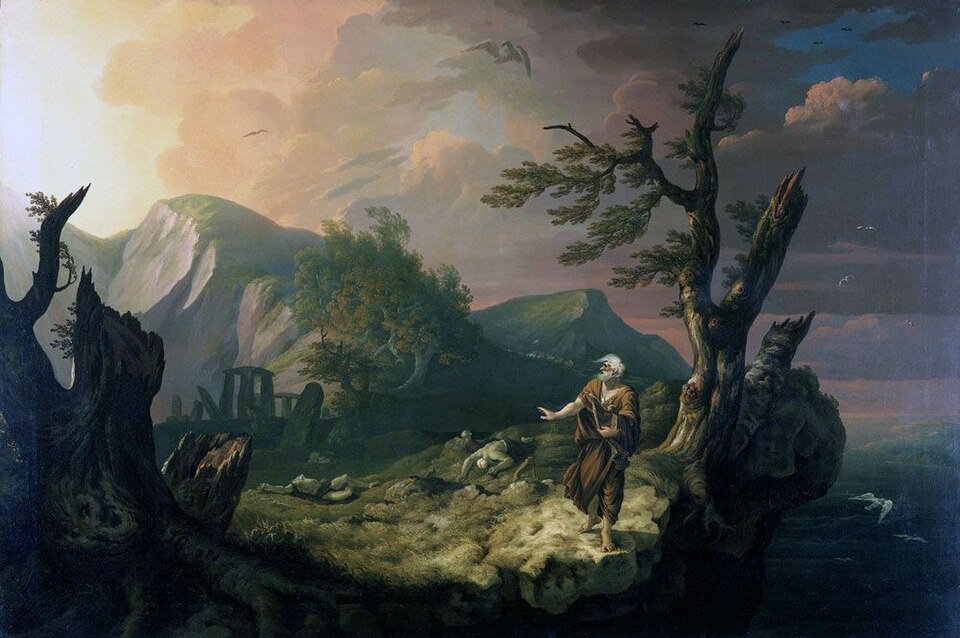
The Bard, 1774, Thomas Jones. Public domain, via Wikimedia Commons. A Welsh image of bardic defiance and cultural memory.
Christopher Nolan’s film of The Odyssey has pushed Homer back into popular conversation: Odysseus trying to get home, Penelope waiting in Ithaca, ships, storms, monsters, gods and the long test of survival.
In the previous Peacock summer post, we looked at Maid Marian as a comic romance of Robin Hood, liberty and life outside official authority. The Misfortunes of Elphin moves into less familiar territory, but it keeps one of Peacock’s recurring interests: the question of what forms of power survive when rank, office and institutions lose their moral authority.
It also reminds us of something easily forgotten when ancient poems sit quietly in books. Homer was not originally a classroom author. The Homeric poems came from an oral world in which stories had to be carried by voices, memories and performances before they were fixed in writing. A bard did not merely entertain. He preserved names, deeds, places, grievances and reputations that might otherwise have disappeared.
A film of The Odyssey is not the same thing as an ancient recitation, of course. But in one respect it moves closer to the old bardic function than a private reading of the poem does. It makes the story public again. It gathers an audience. It retells an inherited tale in a new form, with new emphases, for people who may know little or nothing about the original. Old stories survive because someone does the work of carrying them forward.
This is a good way into Thomas Love Peacock’s The Misfortunes of Elphin, published in 1829. At first glance, it can look like one of the stranger choices in Peacock’s fiction: a comic romance built from Welsh legend, bardic poetry, the story of Taliesin and the drowned land of Gwaelod. Robin Hood is easy to place. Gothic gloom is easy to explain. Welsh myth, for many readers, is less familiar territory.
But Peacock’s choice was not random. He had long been drawn to old literatures, songs and comic ways of looking at the modern world from somewhere outside it. Homer mattered deeply to him; he quoted Homer more often than any other poet. He had also shown an early interest in Welsh material, quoting a Welsh triad as early as 1810 and citing a Welsh ballad two years later. His visits to Wales appear to have deepened the interest, and his marriage to Jane Gryffydh, who was Welsh, gave him another connection to the language and tradition. By the time he came to The Misfortunes of Elphin, he was not simply picking up a remote subject for picturesque effect. He was working with material that had been in his mind for years.
The comparison with Homer is useful, but the contrast matters just as much. Homer gives us Odysseus: active, resilient, cunning, famous, a man who survives by intelligence, endurance and an appetite for return. Peacock gives us Elphin, who is almost the opposite kind of hero. Elphin is not the great man of action at the centre of events. He is a prince whose fortunes repeatedly depend on others: on discovery, patronage, imprisonment, rescue and above all on the bard Taliesin.
That difference is part of the joke, but it is also part of the design. In The Odyssey, heroic action is preserved by song. Odysseus does things, but the poem is how those things reach us. In The Misfortunes of Elphin, song is not only the medium of preservation. It becomes part of the action itself. Taliesin is not simply the person who records events afterwards. He speaks within the story. He judges, challenges, consoles, remembers and helps create the version of events that will survive.
For readers unfamiliar with Taliesin, it is worth pausing over what a bard meant in this kind of world. They were not just private poets writing personal lyrics. In the Welsh tradition, the poet had a public and cultural role. He preserved genealogies, praised patrons, mocked enemies, gave shape to shared history and kept alive stories that were vulnerable to being lost. In societies where writing was scarce, restricted or secondary to oral performance, this work was not decorative. It was necessary.
That kind of preservation is both ordinary and demanding. A story does not float down the centuries by itself. Someone has to learn it, repeat it, alter it, remember it, perform it and pass it on. The medium may be a voice, a manuscript, a printed book or now a film, but the need is recognisably human: to prevent a people’s history, grief, jokes, heroes and warnings from vanishing.
Peacock understood the appeal of that. He spent much of his fiction mocking pretension, but he was never hostile to poetry. What irritated him was solemnity, cant and grand language used to conceal bad thinking. Bardic poetry gave him something different: song as public judgement. In Taliesin, he found a figure who could be learned, comic, resistant and culturally serious at once.
The main legendary materials of the novel are not especially familiar to many readers. Peacock draws on the story of Taliesin’s origin and on the legend of the inundation of the Great Plain of Gwaelod, the drowned land associated with Cantre’r Gwaelod. He also brings in the story of Queen Gwenyvar’s abduction by Melvas. To these inherited materials he adds his own romance, including Taliesin’s love for Melanghel, Elphin’s daughter.
That mixture tells us a good deal about Peacock’s method. He did not treat Welsh legend with the timid fidelity of an antiquarian editor. He studied the material seriously, but he used it freely. Contemporary and later commentators noted the extent of his learning, and Sir Edward Strachey recalled Peacock saying that Welsh archaeologists had treated the book as a serious contribution to Welsh history. That claim should be handled cautiously. Peacock enjoyed learned play, and he was perfectly capable of making scholarship serve satire. Still, The Misfortunes of Elphin plainly involved more historical and literary work than the breezier Maid Marian.
The book also preserves something of the song aspect of its materials, and this is one reason it can feel strange to modern readers. We are used to novels moving forward through scene, psychology and plot. Peacock’s romance often pauses for songs, allusions and bardic utterance. The effect can seem odd if one approaches the book as a conventional historical novel. But it makes more sense if we see Peacock trying, however playfully, to keep the work close to a tradition in which story and song are not separate things.
This does not make The Misfortunes of Elphin an oral poem. It is a printed comic romance by a highly literate nineteenth-century writer. But Peacock is interested in what oral and bardic cultures do: they bind narrative to performance, identity to repetition, and political judgement to remembered speech. The strangeness is part of the experiment. The story also gave Peacock something he always liked: a society far enough from the present to make the present look ridiculous. He was not a simple romantic who believed the past had been better. He was too sceptical for that, and too amused by human folly. But he liked using earlier worlds to expose modern complacency. The past, in Peacock, is not a museum. It is a vantage point.
In Maid Marian, that vantage point was Sherwood Forest. The Robin Hood legend allowed Peacock to imagine a place where outlaws could appear more just than the officers of law. In The Misfortunes of Elphin, the vantage point is bardic Wales. Here the opposition is not quite between law and outlawry, but between corrupt or negligent authority and the story that poets keep alive.
The legend of Gwaelod gives this opposition a practical sharpness. The land depends on sea defences. Someone has to maintain them. Someone has to guard the sluices. A kingdom may dress itself in ceremony, title and power, but if those entrusted with public safety are foolish or drunk, the water will come in. Seithenyn, associated with the disaster, is comic because he is so inadequate to his responsibility. The comedy is not separate from the politics. Peacock is interested in the gap between office and fitness.
That gap appears throughout his fiction. The people with titles are not always the people with judgement. The people who speak most confidently are not always those who understand most. Institutions carry authority, but conduct reveals whether that authority has any moral weight. In The Misfortunes of Elphin, the drowned land becomes an image of public failure: not an abstract tragedy, but the consequence of negligence, appetite and complacency.
Taliesin stands against that failure because he can speak it into lasting form. He does not control armies or embankments. He cannot make the sea retreat by argument. His power is of another kind. He can name folly. He can preserve the story. He can make sure that disaster is not softened into accident or forgotten as mere misfortune. This is where the comparison with Homer becomes clearest. In Homer, the bardic tradition preserves the deeds of men like Odysseus: kings, warriors, wanderers and survivors whose actions would have vanished without song. In Peacock, Taliesin is both participant and preserver. He is inside the story, but he also helps create the story’s survival. Odysseus lives through action carried by poetry. Elphin survives, when he does, through the intervention of a bard whose words become a form of power.
That contrast helps explain Peacock’s unusual choice of hero. Odysseus is a man of resource. He acts, lies, fights, schemes and endures. Elphin is not that kind of figure. His misfortunes make him dependent on intelligence and loyalty that are not entirely his own. That makes him less heroic in the ordinary sense, but more useful for Peacock’s purposes. The book is not about the triumph of a single warrior. It is about what survives when rank, power and luck prove unreliable.
This is also why the novel is drier than Maid Marian. The Sherwood book has more greenwood ease, more song, more romance and more open laughter. The Misfortunes of Elphin is more controlled, more satirical and more learned. Peacock’s high spirits have not vanished, but they are less exuberant. The book is interested in exposing folly rather than simply escaping into festive liberty. That has probably limited its readership. Robin Hood invites people in immediately; Taliesin asks more of them. Yet the reward is considerable. The Misfortunes of Elphin shows Peacock working with a different kind of romance: not the merry outlaw world of English legend, but a Welsh bardic world in which poetry, myth and political judgement are bound together.
The novel is not a manifesto about Wales, and it would be a mistake to treat it as one. Peacock was an English writer using Welsh materials, with all the complications that implies. But it is not merely picturesque borrowing either. He had a genuine interest in the sources, in the songs and in the idea of bardic authority. The comedy is aimed less at Wales than at corruption, incompetence and the human talent for pretending that office and wisdom are the same thing.
What makes the book still worth reading is not that it gives us an accurate sixth-century Wales. It does not. Nor does Homer give us documentary Bronze Age Greece. These are literary worlds, shaped by later transmission, imagination and purpose. What matters is what the shape allows. In Homer, the poem carries forward the wanderings of a man trying to return home. In Peacock, the bard keeps alive the story of a culture in which rulers fail, land is lost and poetry becomes a form of resistance. Odysseus survives through cunning, endurance and the song that carries him. Elphin survives, when he does, because Taliesin can speak.
That is the power of The Misfortunes of Elphin. Its rulers hold office. Its fools make speeches. Its negligent guardians let disaster in. But the bard has the last word.
Maid Marian & The Misfortunes of Elphin is available now in paperback and ebook editions from P-Wave Press and booksellers worldwide.
📚 Explore the book and order here →
The three P-Wave Classics Thomas Love Peacock ebooks are available on Google Play with a tiered series discount during the Peacock summer series.