The Tyranny of the Notification: On Putting Away Our Smart Watches
27 October 2026, Filed in: Pushing the Wave Series | Culture | Digital Life | Contemporary Non-Fiction
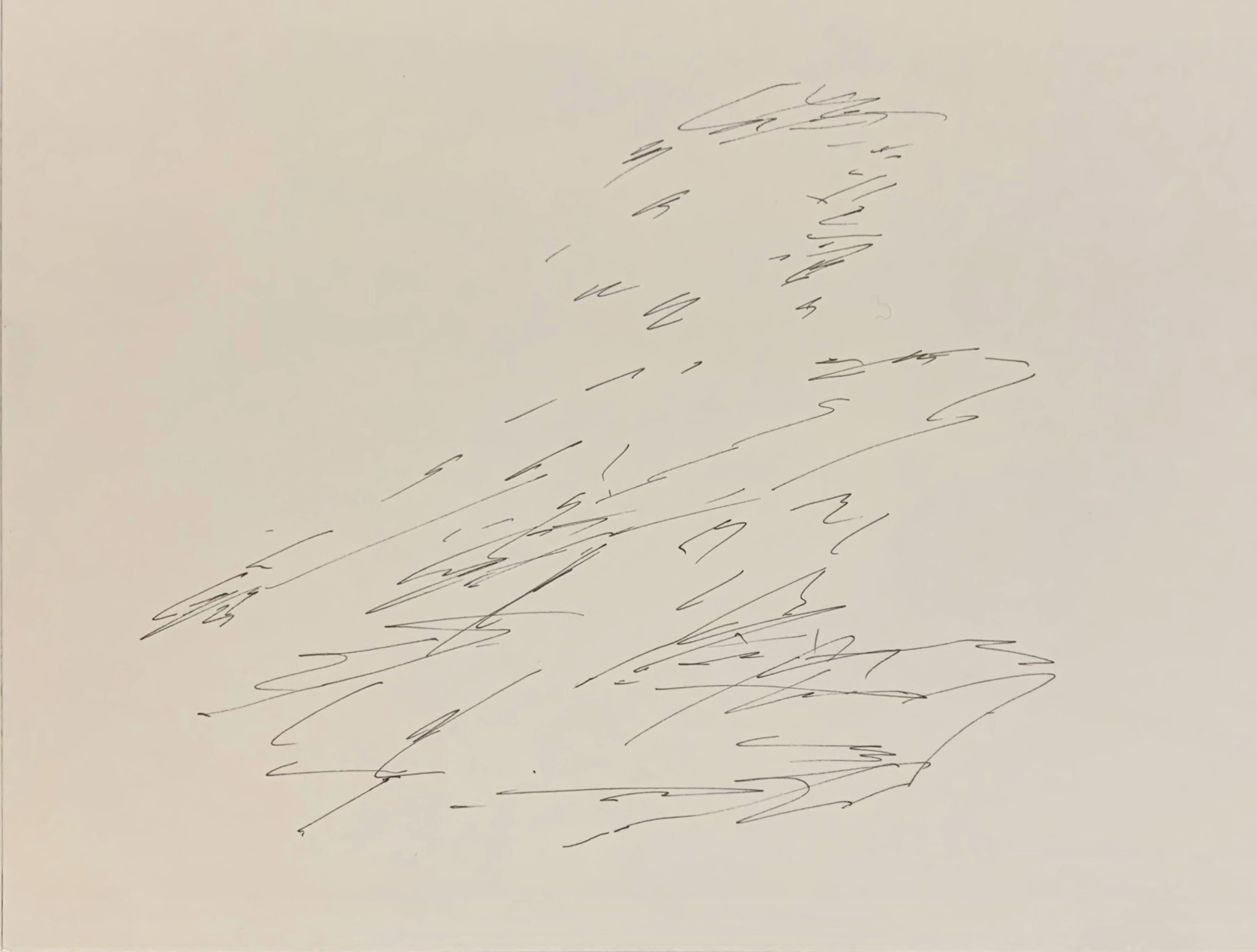
Dancer, 2012. Fine-line ink pens on paper. From Pushing the Wave 2025 by L. A. Davenport.
An essay on P-Wave Press ahead of the publication of Pushing the Wave 2025 (17 November).
In February of last year, the author of Pushing the Wave 2025 did something almost radical: he took off his smartwatch, let the battery run down, and put it in a cupboard. No announcement, no manifesto, no social-media reveal (he had, by then, already quit social media). He simply decided that a device which had spent two years nudging, tapping, and monitoring him had wormed its way a little too far into his life, and that the time had come to push back.
That decision sits at the heart of one of the most striking essays in Pushing the Wave 2025, the fourth annual collection from L. A. Davenport. It is a piece that begins, disarmingly, with a confession: "I was a little nervous in doing so, as if I was doing something wrong; as if, once you've taken the thing off, you're on your own now." A little more naked, a little more alone, a little less cosseted. It is an admission that will be familiar to anyone who has ever felt a phantom buzz on a wrist that no longer carries anything at all.
The cost of being cared for
The genius of the modern wearable is that it does not present itself as an imposition. It arrives as a carer. It celebrates your steps, closes your rings, applauds your sleep, and gently chides you when you have been sitting too long. It is, as Davenport writes, an "assistant, guide, coach and motivator," and it is precisely this benevolence that makes it so difficult to leave behind.
The essay's argument is that the trade has become unbalanced. In exchange for being perpetually cared for, we have accepted perpetual interruption: "all the exercise and movement rings and their daily prompts, and all those notifications, notifications, notifications." The repetition is the point. The device does not ask for a great deal of our attention at any one moment; it asks for a little of it, constantly, forever.
Nor is this the author's first act of technological defiance. Readers of the collection's predecessor will recall his account of "Digital Quitting;" not a detox, but a permanent departure from Facebook, Twitter, Instagram and, most difficult of all, WhatsApp. What surprised him then was not the withdrawal, but the offence taken by others, including friends, that he was no longer reachable on their preferred platform. The smartwatch, he notes wryly, carries no such social penalty: "No danger of that with no longer wearing a watch...unless Tim Cook is about to FaceTime me to personally berate me over my tech choices."
Contrarianism as method
There is a temptation to read the essay as mere crankishness, and Davenport is admirably candid about the ingredients that went into his decision. He admits to "a very contrarian streak," to a reflexive desire to walk in the opposite direction whenever he senses the crowd moving as one. He admits, too, that vanity plays its part: "I don't want to be part of the herd, a sheep. I want to stand out, to be seen, to be noticed." The beard grown in the clean-shaven 1990s, cut back to stubble once beards became boringly ubiquitous, and now abandoned altogether—this is a man who tracks the fashions carefully precisely in order to resist them.
Yet to dismiss the piece as an eccentric's tic would be to miss its more serious argument, which is about examination itself. As Davenport puts it: "Too little is examined; too little is assessed and its merit(s) determined. People crowd together to do certain things in certain ways because other people are doing it, so 'it must be right'."
His illustrating example will be familiar to anyone who has attended a large event: a few hundred people pour out of a theatre at the interval, three refreshment stands await them along the wall, and almost everybody queues for the first one they reach, content to wait ten minutes rather than walk a short distance to be served immediately. We do not choose these behaviours. We inherit them, unexamined, from the crowd.
The smartwatch, in this framing, is the refreshment queue worn on the wrist: adopted because everyone adopts it, retained because everyone retains it, and never once subjected to the simple question of whether it earns its place in our lives.
The watch that earned its keep, and was still dismissed
What elevates the essay above the standard anti-technology screed is that it refuses the easy narrative. Davenport does not regret buying the device. During the COVID-19 pandemic, he writes, he had slipped, like many people, into bad habits, exercising nowhere near as often as before. Unable to bear the idea of a personal coach and harbouring "a horror of the inside of gyms," he found in the watch and its fitness rings an ideal companion: clear goals, set out in an appealing manner, without the need to share or compare. It worked. His fitness climbed beyond the targets he had set himself, and the habits stuck.
This matters, because it means the decision to put the watch away is not a renunciation but a graduation. The author does not throw the device away in disgust; he has, quite deliberately, made himself redundant to it. "I have integrated beneficial exercise habits into my day-to-day life in a way that is sustainable, and so no longer fear I will slip back into the bad old ways." The technology was scaffolding, and the building now stands without it.
The essay's most charming note is reserved for what will be lost: February's Move goal, and the little animated shield he will now never collect. "Will I ever be able to live with myself?" A joke, but also the whole pathology of the gamified life in miniature: the moment when the badge becomes the reason, and the walk merely the means of acquiring it.
Why this matters to us
At P-Wave Press we publish books that tackle the settled assumptions of the present, and this essay is one of the sharpest examples in this year's collection. It is not a lament for a pre-digital golden age, and it is not anti-technology; indeed, the same book contains an enthusiastic appreciation of streaming services, a twenty-two-disc Charles Ives box set and the pleasure of vinyl acquired for five euros at a flea market. The question the essay poses is not whether to use technology but on what terms. Its answer is that the terms must be reviewed, honestly and periodically, rather than renewed automatically because renewal is the default.
That is an uncomfortable proposition for an industry that profits from the default, and it is one reason we think this collection deserves a wide readership. The strongest writing about technology rarely comes from the technology press; it comes from writers prepared to describe, without melodrama, what it actually feels like to wear it, rely upon it, miss it, and finally set it aside.
There is, finally, a pleasing irony in publishing this argument in a physical book: printed on demand, dispatched directly to readers as orders arrive, and equipped with footnotes setting the work in its intellectual, cultural and historical contexts, written for the general reader. No rings to close. No badges to earn. The pages do not notify you of anything. You may, if you wish, read it in an afternoon and then put it in a cupboard with a dead battery, though on the evidence of this collection, we suspect you will keep it within reach.
Pushing the Wave 2025 by L. A. Davenport will be published by P-Wave Press on 17 November in premium hardback and paperback, with footnotes setting the work in its intellectual, cultural and historical contexts, written for the general reader, and printed on demand and dispatched directly to readers as orders arrive.
Explore the book and preorder here:
Pushing the Wave →