Tuesday Book Club: The Master and Margarita by Mikhail Bulgakov
A Wild, Fearless Tale for Dangerous Times
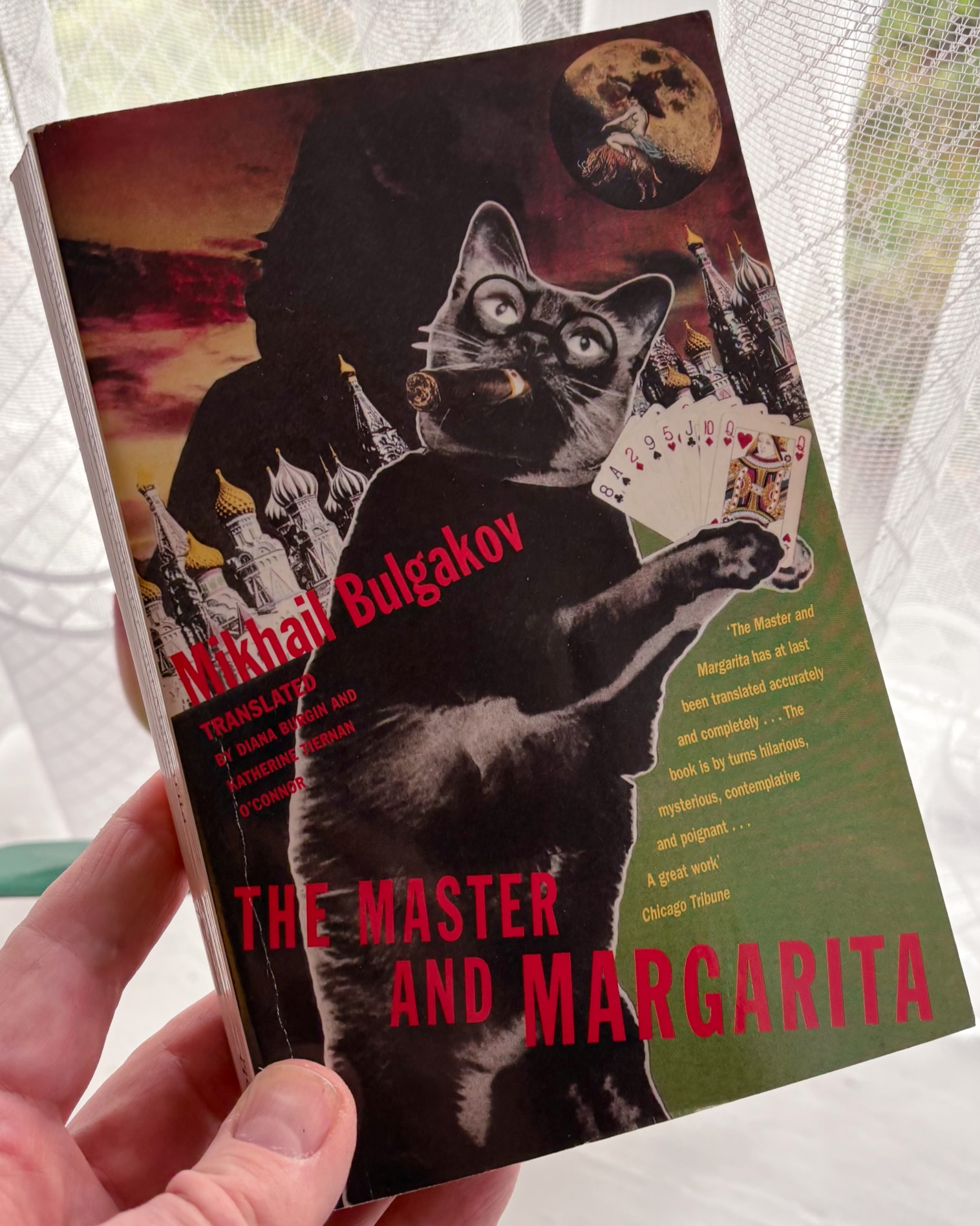
This week’s Tuesday Book Club choice is The Master and Margarita by Mikhail Bulgakov, in the superlative translation by Diana Burgin and Katherine Tiernan O’Connor—a novel that, when I first read it over twenty years ago, completely rewired my brain.
It was my Polish wife at the time who insisted I read it. She told me it would tell me about the profound, melancholic depths of the Slavic soul, none more so than in Russia; and that the book would show me how authoritarianism doesn’t just take over a country—it seeps into the way people think. She knew what she was talking about: she had grown up in Communist Poland, with all its absurdities and tragedies. And she was right: it blew my mind. I’d never read anything like it. And I still haven’t.
A novel of dual worlds and fractured realities, The Master and Margarita is equal parts satire, tragedy, political parable and supernatural romp. Satan arrives in 1930s Moscow, accompanied by a wisecracking, oversized cat and a gang of chaotic agents, just as the city is caught in the tightening noose of state paranoia, informants and ideological conformity.
But the brilliance of the book lies in its layering. There’s also a novel within the novel, telling the story of Pontius Pilate and Yeshua (Jesus), and a love story—aching, broken, and defiant—that defies time, space and censorship.
It’s wild. It’s funny. It’s profound. It’s full of rage and beauty and absurdity. And in today’s climate, with its creeping authoritarian tendencies, casual gaslighting of truth, and cults of certainty, it feels more urgent than ever.
This isn’t just literature. It’s a firebomb. A coded message smuggled out of the jaws of oppression. A novel that reminds us that storytelling—when done right—is dangerous in the best possible way.
Let’s Talk About It
Have you read The Master and Margarita? What did you make of its bizarre brilliance? Did you fall for Behemoth the cat? Or feel the chill of its political bite?
Share your thoughts using #TuesdayBookClub and #MasterAndMargarita on X (formerly Twitter) and Bluesky—and let’s talk about how fiction still matters when the world tilts off balance.