The Female Quixote, Volume II: Where Imagination Meets the World
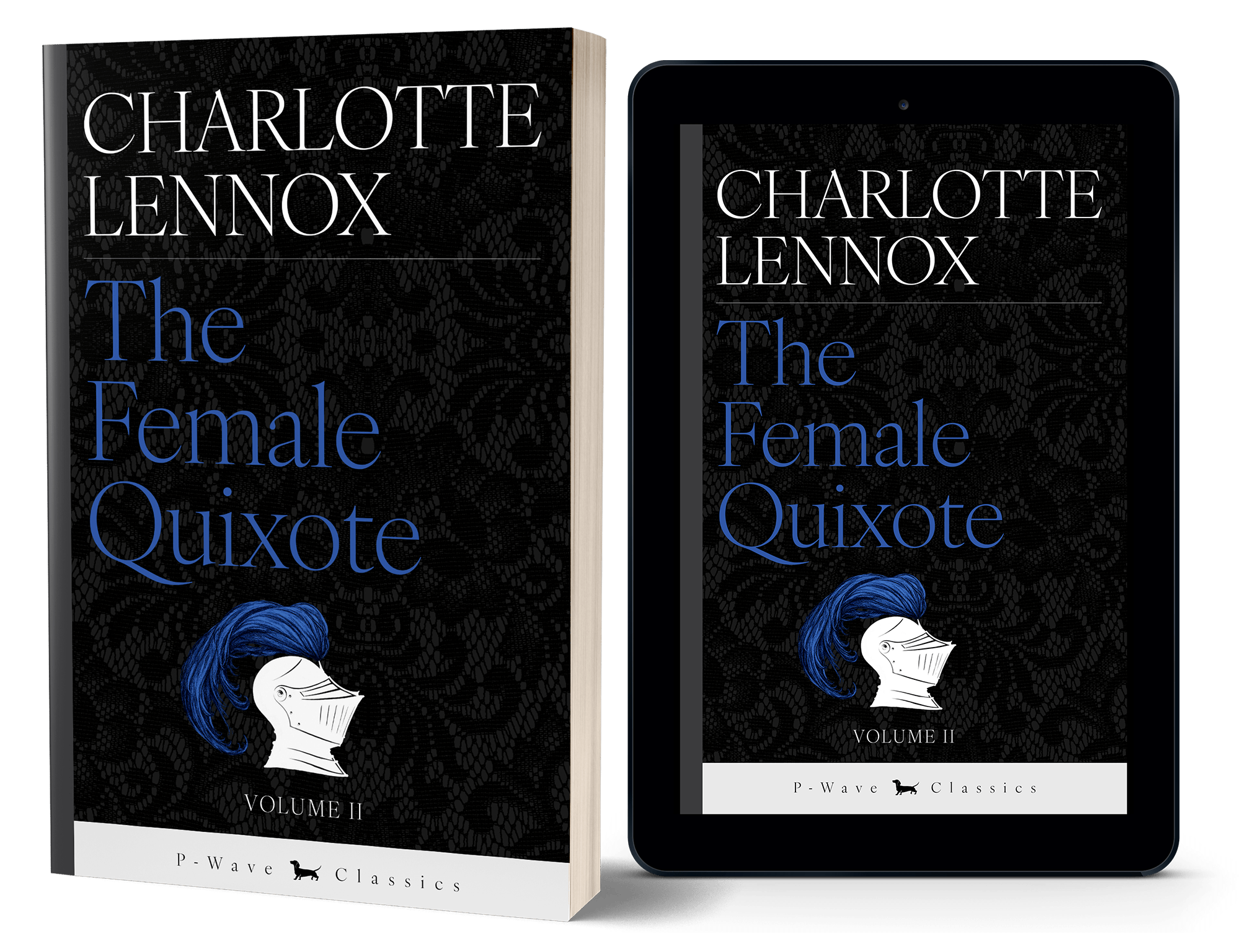
On 15 September, P-Wave Classics publishes Volume II of Charlotte Lennox's The Female Quixote; or, The Adventures of Arabella, completing this restored two-volume edition of a remarkable 1752 novel.
Where Volume I introduced us to Arabella in the seclusion of her father's castle—a young woman whose understanding of life has been shaped entirely by the heroic romances of seventeenth-century France—Volume II brings her into an ever-widening collision with the social world she has only ever read about.
The shift is consequential. In the first volume, Arabella's romance-inflected interpretations of events are mostly contained within a domestic setting, where her father's indulgence and her own isolation shield her from contradiction. Her mistakes are comic, but they are also harmless; the product of a mind working logically from premises that simply happen to be wrong. Volume II changes the stakes.
The death of the Marquis marks a turning point, not only in plot but in power. Arabella is removed from the world that protected her and placed among people who do not share her assumptions and have little patience for them. Her movements, her speech and her expectations are increasingly regulated by others. What was once charming eccentricity becomes, in the eyes of society, a problem to be managed.
Lennox handles this transition with characteristic subtlety. She does not abandon comedy. There are scenes of tremendous wit as Arabella encounters London society, navigates courtship and rebukes suitors with the full apparatus of romance ethics. But the laughter sharpens. Figures such as Miss Glanville, Sir George Bellmour and the Countess represent different responses to Arabella's behaviour, ranging from opportunism and mockery to sympathy and patient instruction. Lennox is particularly attentive to the dangers posed by those who exploit Arabella's beliefs for amusement or advantage. These episodes introduce a harder edge to the comedy, reminding us that misunderstanding can invite coercion as well as laughter.
What makes Volume II so compelling is Lennox's refusal to simplify the conflict it dramatises. Arabella is not a mere object of ridicule, nor is she presented as a passive victim of bad education. She is articulate, morally serious and capable of sustained argument. Her conversations—particularly those in which she interrogates intentions, defends heroic severity or rebukes the casual flirtations of polite society—are among the most intellectually lively passages in the book. Lennox trusts her heroine enough to let her be wrong in interesting ways.
At the same time, Lennox does not present modern social norms as unquestionably superior. The world Arabella encounters is not uniformly rational or kind. Polite society is governed by convention, calculation and compromise, often at the expense of moral clarity. In this respect, Arabella's romance-inflected expectations serve as a form of critique. Her astonishment at insincere gallantry and ambiguous intentions exposes the thinness of certain social rituals. Lennox allows romance values to illuminate the deficiencies of modern manners even as she demonstrates their impracticality.
The novel's famous resolution—Arabella's "cure"—has long been one of the most debated passages in eighteenth-century fiction. Without rehearsing the arguments here, it is worth noting that Lennox does not present it as a straightforward triumph of reason over delusion. The process by which Arabella is guided away from romance ideals also entails a reduction of her independence. What is gained in social conformity is not unambiguously gained in liberty. The novel never entirely resolves this tension, and it is in that irresolution that much of its power lies.
Earlier this year, alongside the publication of Volume I, we published a series of essays exploring some of the novel's major themes:
- The Female Quixote Is Not a Female Don Quixote: why Lennox's novel is far more than a simple adaptation of Cervantes' premise.
- Arabella Lives Inside Fiction: how stories shape identity, perception and our understanding of reality.
- Arabella Refuses to Dress Properly: clothing, spectacle, femininity and social discipline in eighteenth-century society.
- The Price of Becoming Sensible: why Arabella's famous cure remains one of the most intriguing and ambiguous conclusions in eighteenth-century fiction.
That final essay speaks most directly to what readers will find in Volume II. The question it poses—what is lost when imagination is corrected?—runs through every chapter of this second volume. Lennox does not offer easy comfort. Instead, she leaves us with a heroine whose journey is not a descent from fantasy into submission, but a movement, uneven and incomplete, towards accommodation.
More than two and a half centuries after its publication, The Female Quixote remains witty, surprising and intellectually provocative. It is a novel about books, imagination and the stories through which people understand themselves and the world around them. Above all, it is a reminder that becoming sensible may sometimes be more complicated than it first appears.
Volume II will be available from 15 September in paperback and ebook editions from P-Wave Press and booksellers worldwide.
📚 Explore the book and pre-order here →