The Female Quixote, Volume I: Imagination, Reality and the Power of Books
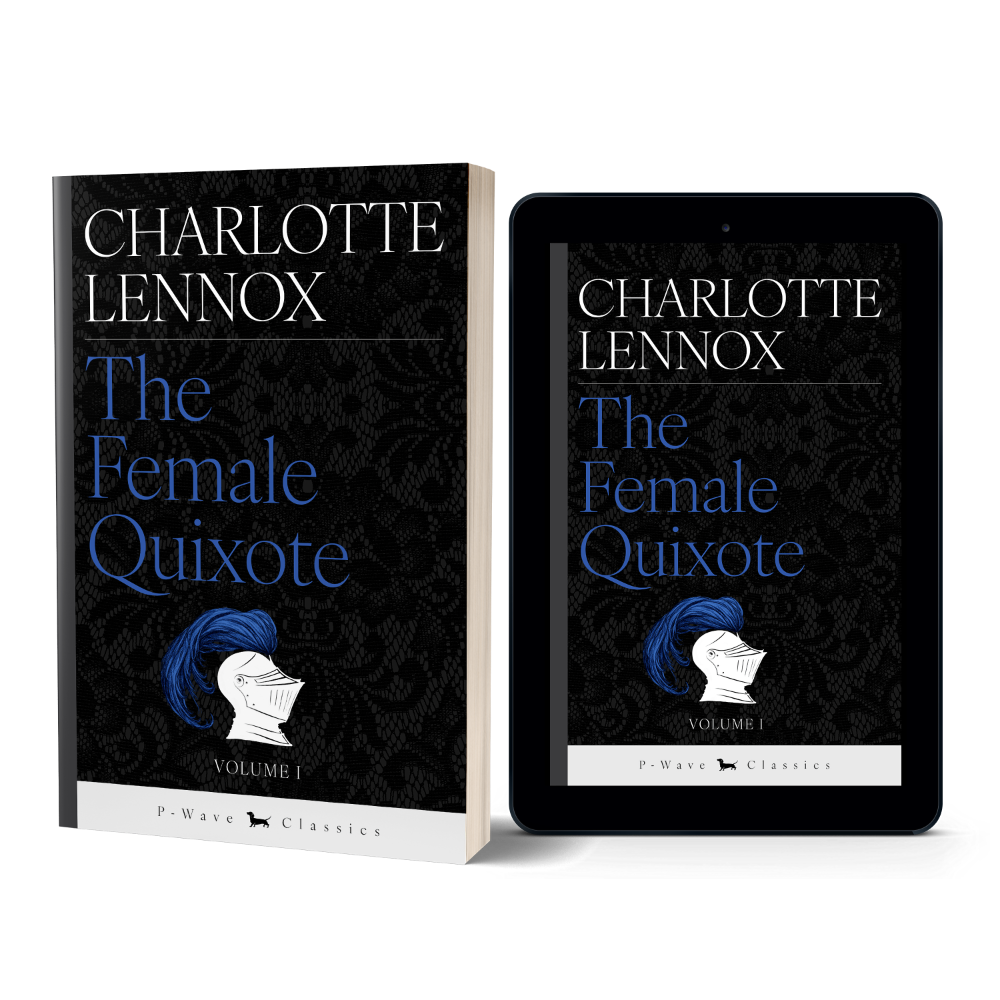
We delighted to announce the launch of The Female Quixote, Volume I, Charlotte Lennox’s remarkable 1752 novel, now restored to its original two-volume form as part of the P-Wave Classics series, to be published on 23 June 2026.
At first glance, The Female Quixote presents itself as a comedy of misunderstanding. Its heroine, Arabella, the daughter of a marquess, has formed her view of life and love from the heroic romances of seventeenth-century France. Convinced that the world operates according to their elevated codes of honour, devotion and adventure, she interprets every encounter through their logic, often to the bewilderment of those around her.
Yet to read the novel simply as a satire of outdated literary fashions is to miss its deeper ambition. Lennox’s achievement lies in the seriousness with which she treats the imaginative life. Arabella is not merely deluded; she is consistent, intelligent and morally rigorous. The world she inhabits may not conform to her expectations, but her expectations themselves are not without coherence or value. What the novel explores, with increasing subtlety, is not just the gap between fiction and reality, but the consequences of taking fiction seriously.
This is, in many ways, a novel about reading: about what it means to internalise a body of literature so completely that it begins to structure one’s understanding of experience. Arabella does not simply imitate the romances she has read; she lives within them. They provide her with a language for interpreting behaviour, for judging character and for imagining her own place in the world. In doing so, they grant her a kind of intellectual and emotional freedom that is otherwise difficult to achieve within the constraints of eighteenth-century English society.
That freedom, however, comes at a cost. The further Arabella’s imagination extends into the patterns of romance, the more it brings her into tension with the social world around her. The novel’s comedy arises from this collision, but it also gives rise to moments that are more unsettling than amusing. Lennox invites the reader to consider not only the excesses of romance, but the limits of the world that rejects it.
In restoring The Female Quixote to its original two-volume form, this edition also seeks to restore something of its original rhythm. The novel unfolds not as a brief conceit, but as an extended engagement with its central questions. Arabella’s ideas are tested, challenged and reasserted across a sequence of encounters that gradually deepen rather than resolve the tensions at the heart of the work.
Alongside the text, Volume I includes an introduction, a biographical essay, and an extended exploration of the world of French romance, together with a glossary designed to orient the modern reader within a literary tradition that was already beginning to seem distant in Lennox’s own time. These materials are intended not to explain the novel away, but to make its imaginative framework more legible, and, perhaps, more compelling.
More than two and a half centuries after its publication, The Female Quixote remains strikingly contemporary. It asks questions that continue to resonate: how far should we allow books to shape our expectations of life? What happens when imagination refuses to submit to experience? And what forms of freedom, or constraint, emerge from that refusal?
Arabella may be out of step with her time. But it is not always clear that her time is entirely in step with itself.
📚 Explore the book and pre-order here →