The High Street as Cultural Heartbeat: Why Bookshops Must Be Saved
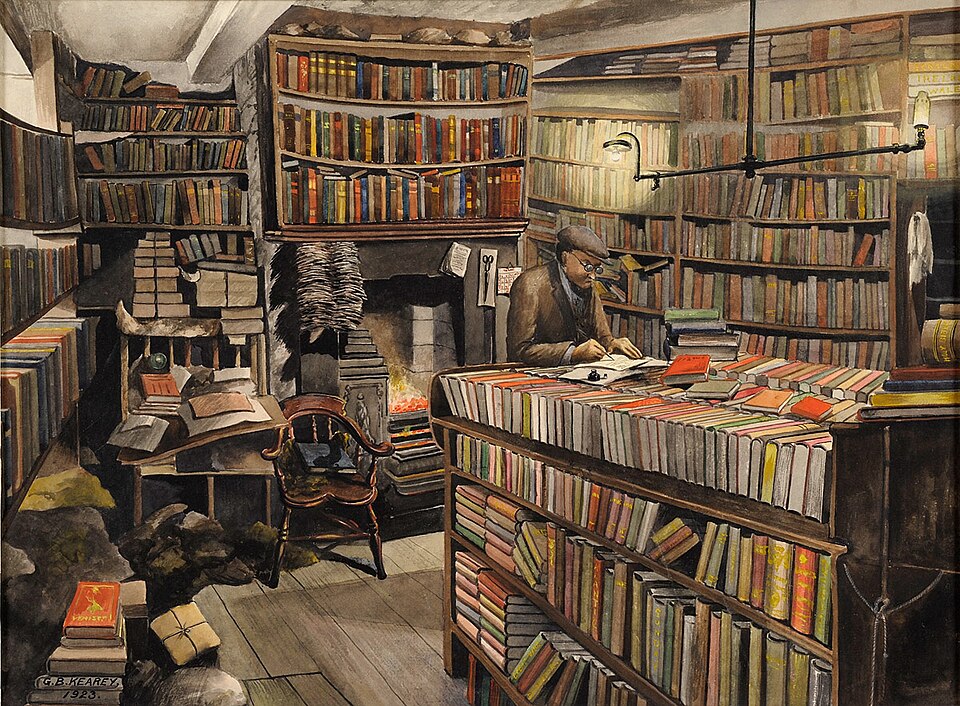
Bookshop (1923), George Baxendale Kearey. Via Wikimedia Commons (public domain). A hundred years on, such spaces remain as essential as ever, yet now face unprecedented pressure from rising business rates.
By the Editor, P-Wave Press
Last week, The Bookseller and The Stage joined forces to send an open letter to the Prime Minister, calling for urgent government action on business rates. The message was stark: without targeted relief, the UK stands to lose its bookshops and theatres, the very venues that anchor our communities and sustain our cultural life.
As a small independent publisher, P-Wave Press does not usually weigh in on fiscal policy. Our focus is typically on the manuscripts we acquire, the books we print, and the stories we tell. Yet, the crisis facing independent retailers is not merely a commercial concern; it is an existential threat to the entire literary ecosystem. As such, we fully support this initiative.
The Contradiction of Policy
The irony of the current situation is difficult to ignore. The government has declared a National Year of Reading, championing literacy and the joy of books. Simultaneously, however, the policies governing business rates are effectively dismantling the physical spaces where that reading culture thrives.
According to the Booksellers Association, the average independent bookshop in England faces a rates bill that could force them to sell an additional 1,141 books every year just to break even by 2029–30. For many, this is impossible. As one bookseller told The Bookseller, the numbers are "so frightening" they cannot bear to look at them. Meanwhile, pubs, clubs, and live music venues have been granted a 20% discount on their rates—a move the government rightly frames as protecting "the beating heart of our communities."
Why are bookshops excluded from this definition?
More Than Retail Outlets
For P-Wave Press, bookshops are not simply points of sale. They are the essential interface between our work and the reader. In an increasingly digital world, the act of browsing a shelf remains the most natural, organic, and serendipitous way for a reader to discover a new voice. A cover caught by peripheral vision, a blurb read while waiting for a friend, or a recommendation from a knowledgeable bookseller—these are moments of connection that algorithms cannot replicate.
Without these physical hubs, we lose the ability to introduce our books to potential audiences in the way they were intended. We become isolated entities, shouting into the void of online marketplaces, disconnected from the tactile reality of reading.
The loss would be profound. As The Stage noted regarding theatres, these venues cannot simply relocate or downsize without destroying their purpose. The same applies to bookshops. They are fixed points in the geography of a town, providing education, literacy, and screen-free entertainment. They are the libraries of the high street, offering a curated space for community gathering that goes far beyond the transaction of buying a book.
A Call for Consistency
The letter signed by editors Philip Jones and Matthew Hemley, and supported by hundreds of booksellers and authors including Philip Pullman and Maggie O’Farrell, makes a compelling case: if the government truly believes in the value of reading, it must value the places that enable it.
We agree. The cultural fabric of the UK is woven from these threads—the local theatre, the independent bookshop, the library. To allow them to wither under the weight of unsustainable taxation would be to unravel that fabric stitch by stitch.
P-Wave Press stands ready to support any initiative that secures the future of independent bookshops. Whether through business rates relief, grants, or other targeted measures, the priority must be clear: protect the spaces where stories come alive. If we lose these places, we do not just lose shops; we lose the heartbeat of our cultural life.
Let us hope the government listens before it is too late.