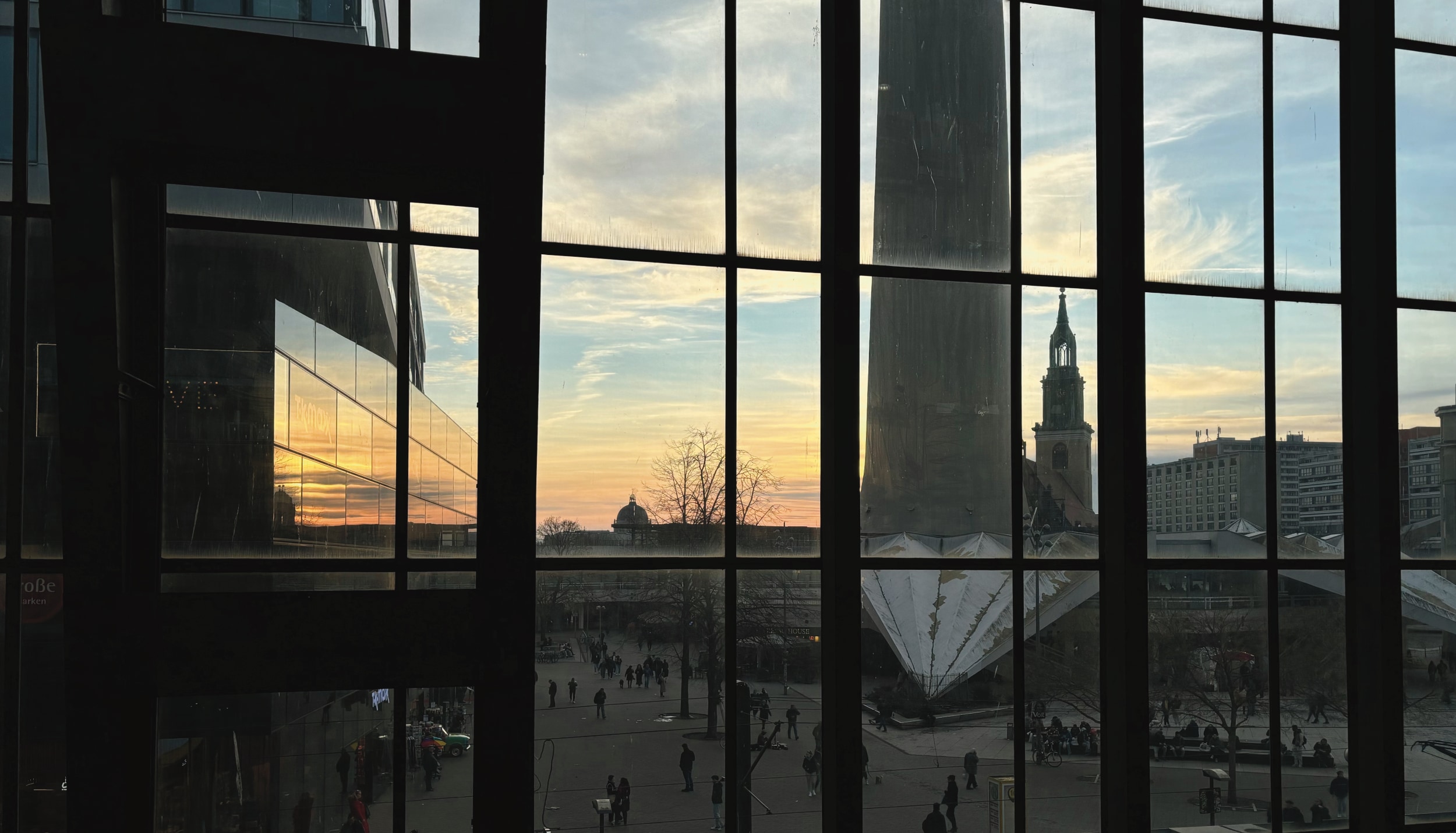
Berlin TV Tower from Alexanderplatz station, 2025. From Pushing the Wave 2025 by L. A. Davenport. An essay on P-Wave Press ahead of the publication of Pushing the Wave 2025 (17 November).
❦ ❦ ❦
Some travel writing is a celebration; some is a warning. The travel writing in Pushing the Wave 2025, the fourth annual collection from L. A. Davenport, is neither. It is something rarer: a chronicle of returns, and of the discovery that a return is never quite what it promises.
The book's travel sections take the author to Vienna, which he calls "a kind of second home", to the Italian-Swiss charms of Lugano, and twice to Berlin, the city that anchors the volume. On the surface, these are pleasurable dispatches: a modern classical concert at the Berlin Philharmonie, a singspiel at the Volksoper, an Ethiopian restaurant that he rates among the best he has encountered, and a night dancing in an underground Berlin club "where the bass was so powerful it made my clothes shake." Any reader seeking a travel guide will find one here, with unusually good restaurants in it. But the deeper subject is announced in the collection's Berlin piece, dated March 2025, and it is not Berlin at all.
The impossible return
After two years away, Davenport returned to a city that has always felt like a home away from home, and its "vibrancy and restless energy were a joy to experience." And yet, amidst the thrill of rediscovery, he writes, "I felt an undeniable sadness." Not because of anything that happened there. The sadness was "a growing awareness of time's passage and the impossibility of returning to an earlier version of the city, and of myself."
The specifics are unheroic and all the more telling for it. The friends who once lived in Prenzlauer Berg, before the neighbourhood transformed into "a haven for well-heeled hipster families from Stuttgart", have moved on. The cafés they frequented "have vanished", and with them, he writes, "a piece of my own history." This is a familiar experience for anyone who has ever revisited a city of their youth, but the essay pushes past the sentiment into something harder, in a passage of questions that the book declines to resolve:
"What was I mourning? The inevitability of time? The loss of youth? Or was it the realisation that I had never truly lived in those moments as fully as I could have; that I was too often distracted by the past or preoccupied with the future to appreciate the present?"
The mourning, in other words, may not be for the vanished city. It may be for the inattentive self — the one who was physically present in those lost cafés and mentally elsewhere. Presence and absence are the collection's real subjects, and the Berlin essay returns to them until they become its method.
Standing in the station
The essay's most affecting moment comes on the platform at Alexanderplatz station, watching the sunset paint the city. It is there, amid the trains, that "I understood how definitively one can become cut off from one's past," and there that a lyric arrives, unbidden, from U2's "Zoo Station", the opening track of Achtung Baby, their love letter to Berlin:
"Time is a train / Makes the future the past / Leaves you standing in the station / Your face pressed up against the glass."
The book's photograph of the station at sunset, with the TV Tower looming over the square behind its glass wall, freezes that instant. But the essay does not linger at the platform. It walks, as its author walks, into the Museum of Photography, where two encounters complicate the argument. Faced with Helmut Newton's confrontational images — women who "hold your gaze, daring you to meet their eyes", "statuesque, superior, looking straight at the viewer rather than merely being looked at" — the author finds art that refuses nostalgia, that exists entirely in the exchange of the present moment. And in the Max Ernst exhibition, he finds the opposite lesson in a kindred spirit: an artist who was "a wanderer, moving seamlessly between drawing, painting, etching, collage and innovative photographic printing techniques", playful, at ease in his own image, and celebrated less than his talent deserved by "the quirks of history."
The two exhibitions sharpen the essay's conclusion. Art, the author argues, "whether in Newton's confrontational photography or Ernst's playful Surrealism, provides a way of anchoring ourselves in the present, and of seeing the world as it is rather than as we wish it were." Which is precisely what he could not do, by his own admission, in those vanished Berlin cafés. Standing at Alexanderplatz, he writes, "I could not shake the feeling that I was standing at a threshold; not just between past and present, but between the person I was and the person I am still becoming."
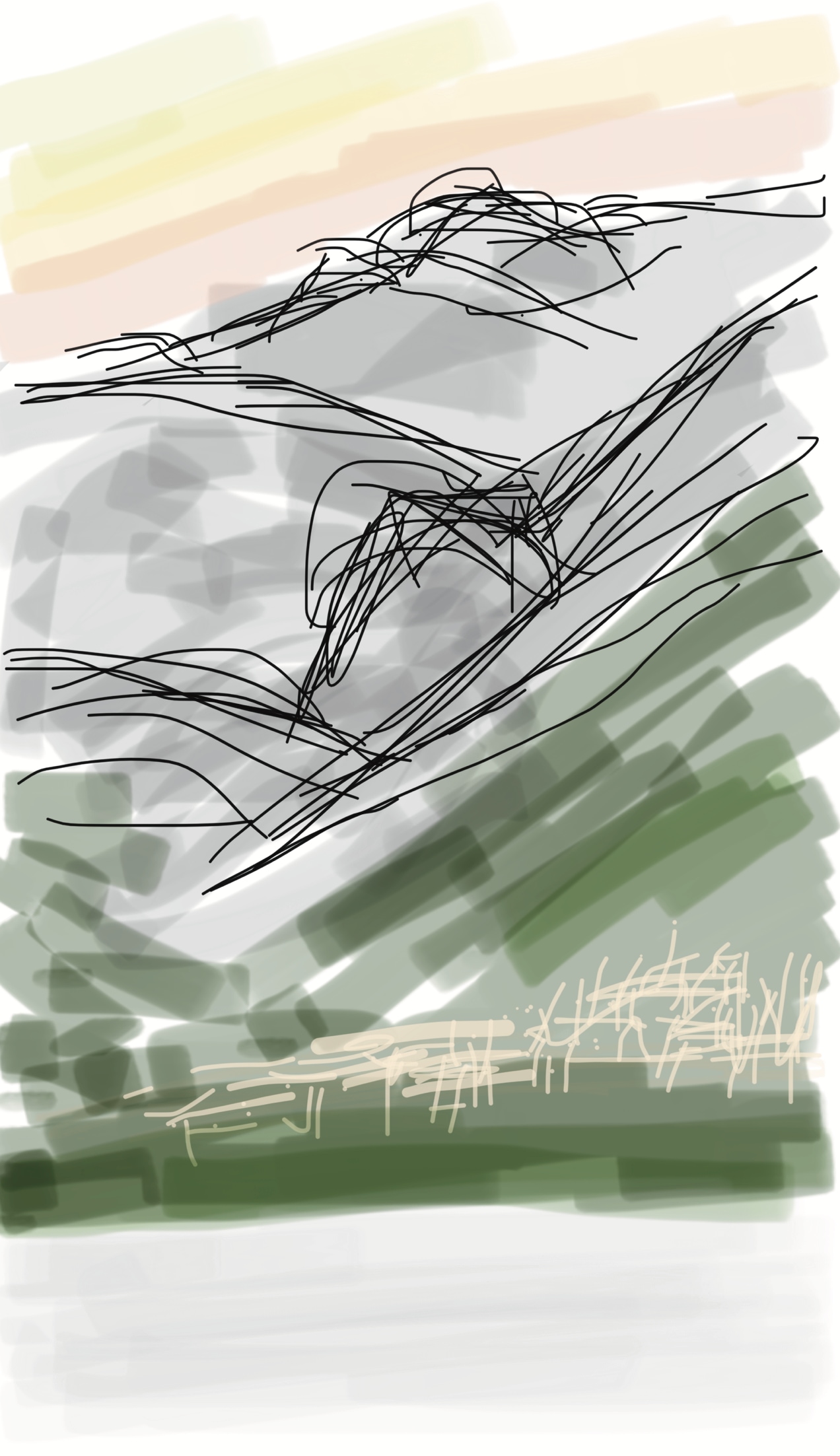
Sunset over Lake Lugano, Switzerland, 2025. "This sketch was created using the Notes application on an iPhone while having dinner at La Taverna del Pittore. This was my first experiment with colour in the Notes app, and made me wish I had brought my artist materials with me." From Pushing the Wave 2025 by L. A. Davenport.
Places, and how to see them
The later travel pieces extend the argument, and complicate its melancholy. In "On the Road Again", the author's Vienna is affectionate, cosmopolitan, and funny: an unlooked-for hotel by the Hauptbahnhof becomes a licence to discover unknown neighbourhoods; an evening of operetta ends in a techno club with "one of the best sound systems I have heard." The piece opens with a resolution, "no matter how much we have going on in life and no matter where we are, we should always take time to appreciate what we have around us," and then, characteristically, proceeds to collect evidence of how rarely we manage it.
The gallery of failures is comic. The writer Marie Le Conte, who "loathes" Vienna for being tutted at for jaywalking. A visitor to Paris whose negative verdict on the city was, in its entirety, "because it rained." A young American on a train from Zurich to Lugano who disliked Berlin because it rained there and liked Prague because it was sunny, leaving his fellow passenger, the author reports, "lost for words." To dismiss a city over its weather, the essay concludes, "is frankly ridiculous", but the episodes serve the larger theme: these are travellers who were never present in the places they visited at all, and so came home carrying nothing but grievances against the atmosphere.
Against this, the Lugano section models the alternative: the "extremely enjoyable stroll alongside the lake every morning and evening", which the author calls "a balm to the soul." The book's own sketch of the sunset over the lake is the lesson in miniature. It was made on an iPhone, in the Notes application, over dinner at La Taverna del Pittore, the author's first experiment with colour in the medium, and its loose, hurried lines, dashed off with whatever came to hand rather than proper artist's materials, capture the evening precisely because they do not try to pin it down.
And it is in Lugano that the collection quietly completes its circle. Among the exhibitions he visits are the photographs of Eugenio Schmidhauser and Roberto Donetta, early twentieth-century chroniclers of the Ticino, who captured the everyday "with the wistfulness that comes of realising that this way of life would soon disappear forever."
Those photographers, holding on to a vanishing world, are the Berlin essay's mirror image: where the author mourns the scenes he failed to notice while they lasted, Schmidhauser and Donetta noticed theirs with the foreknowledge that noticing is all you can do. The book does not labour the parallel. It simply sets the two alongside each other and lets the reader stand between them, looking at time's passage from both directions at once.
Why this matters to us
Across the Pushing the Wave series, travel, place, identity, and the shifting border between presence and absence have recurred as themes, and in this fourth volume they are woven together with a confidence that rewards reading the collection whole. The travel writing is neither brochure nor memoir but argument: every city is an occasion for the same question: where, and when, am I; and every return trip is both an answer and a refutation of the last one.
It is also, we would suggest, the thread that ties this volume to the two essays discussed earlier on this blog. An essay on setting aside the smartwatch, an essay on machines that speak with our collective voice, and an essay on cities that vanish between visits: each is about attention, about what we are present for and what we absent ourselves from. The series argues, across all three, that the present is a place, perhaps the only place, where attention is the residency requirement.
We publish books that ask such questions without promising tidy answers. The Berlin essay ends with its author at a threshold, and the reader is left standing beside him, face pressed up against the glass, watching time make the future the past. It is a discomforting place to be left. It is also why the collection stays with you: the trains come and go, the café on the corner becomes a babywear boutique, and the book remains on the shelf, holding the moments steady.
❦ ❦ ❦
Pushing the Wave 2025 by L. A. Davenport will be published by P-Wave Press on 17 November in premium hardback and paperback, with footnotes setting the work in its intellectual, cultural and historical contexts, written for the general reader, and printed on demand and dispatched directly to readers as orders arrive.